Work in Progress — This is an active research project. Content is incomplete, speculative, and subject to change.
Experiments
V18: Boundary-Dependent Lenia
V18: Boundary-Dependent Lenia
Addition: Insulation field via iterated erosion + sigmoid creating genuine boundary/interior distinction. External FFT signals gated by (1−insulation), internal short-range recurrence gated by insulation.
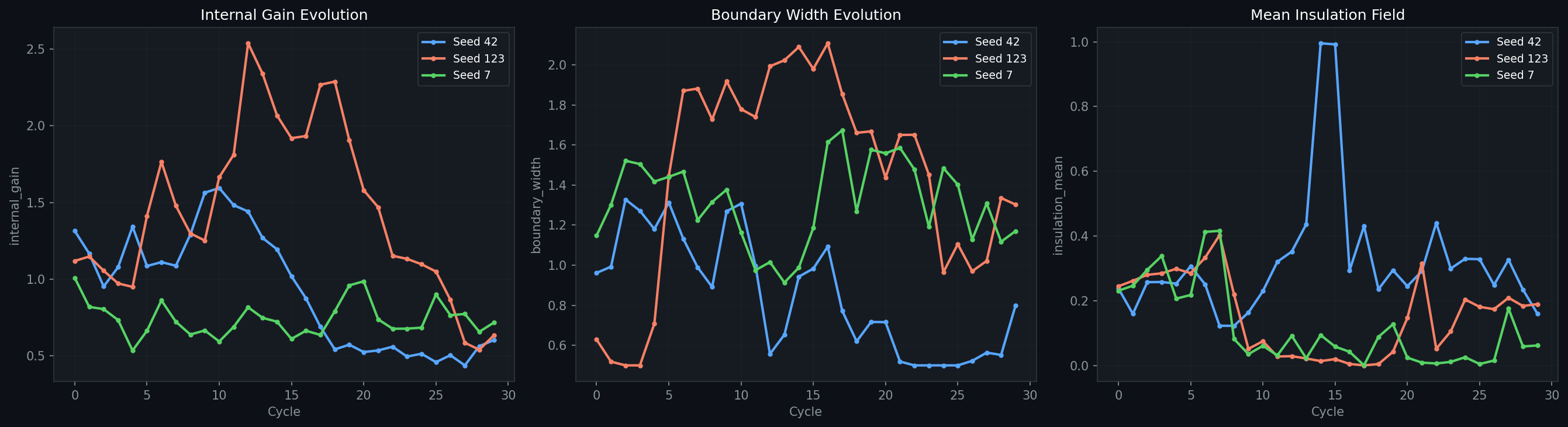
Three seeds, 30 cycles. Mean robustness 0.969 — highest of any substrate. Peak 1.651 (seed 42). 33% of cycles show Φ increase under stress.
Surprise: internal_gain evolved down in all three seeds (1.0 to ~0.6). Evolution preferred permeable membranes over insulated cores. External sensing was more valuable than internal rumination.
Verdict: Best engineering result (highest robustness) but not the theoretical goal (breaking the coupling wall).
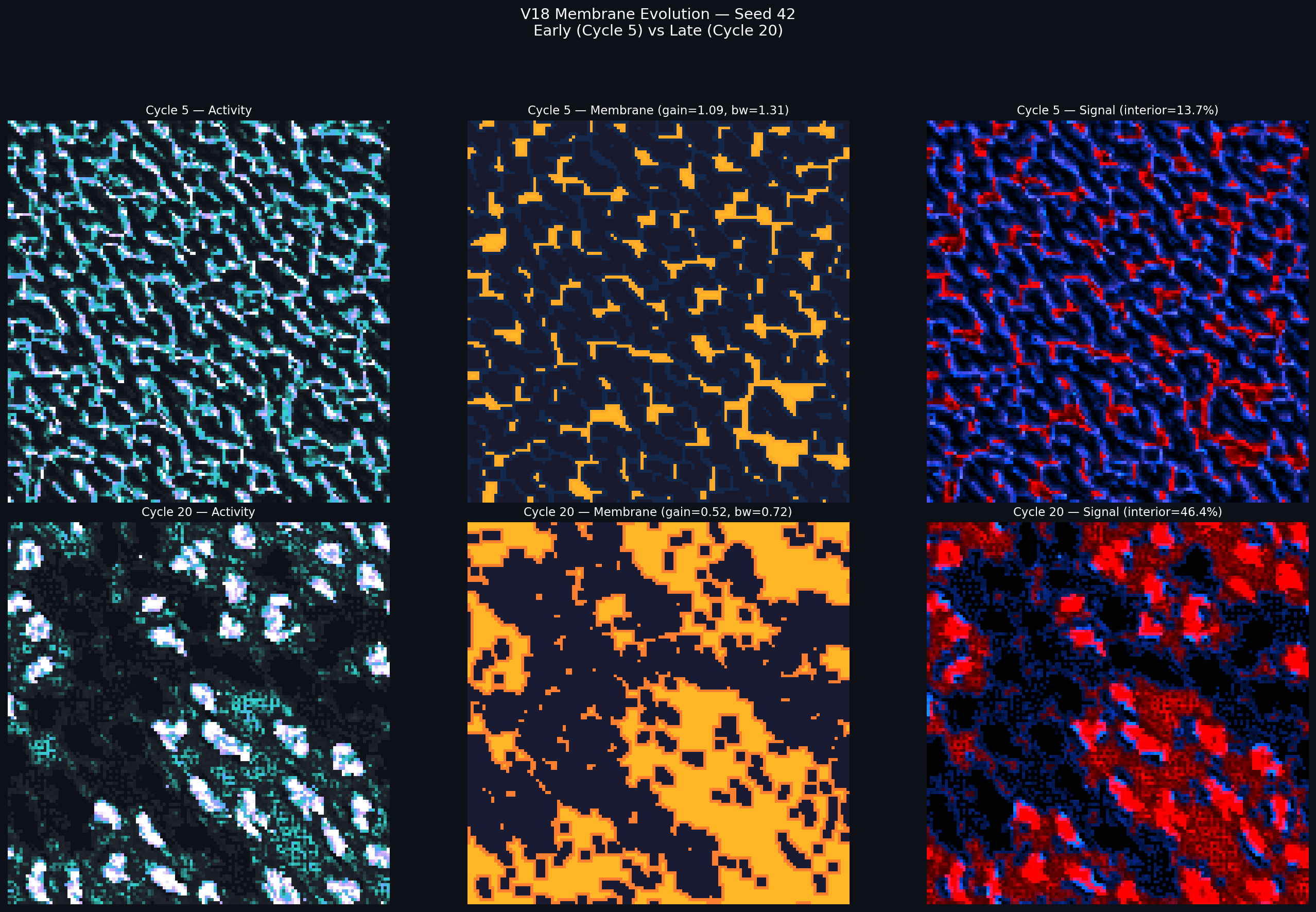
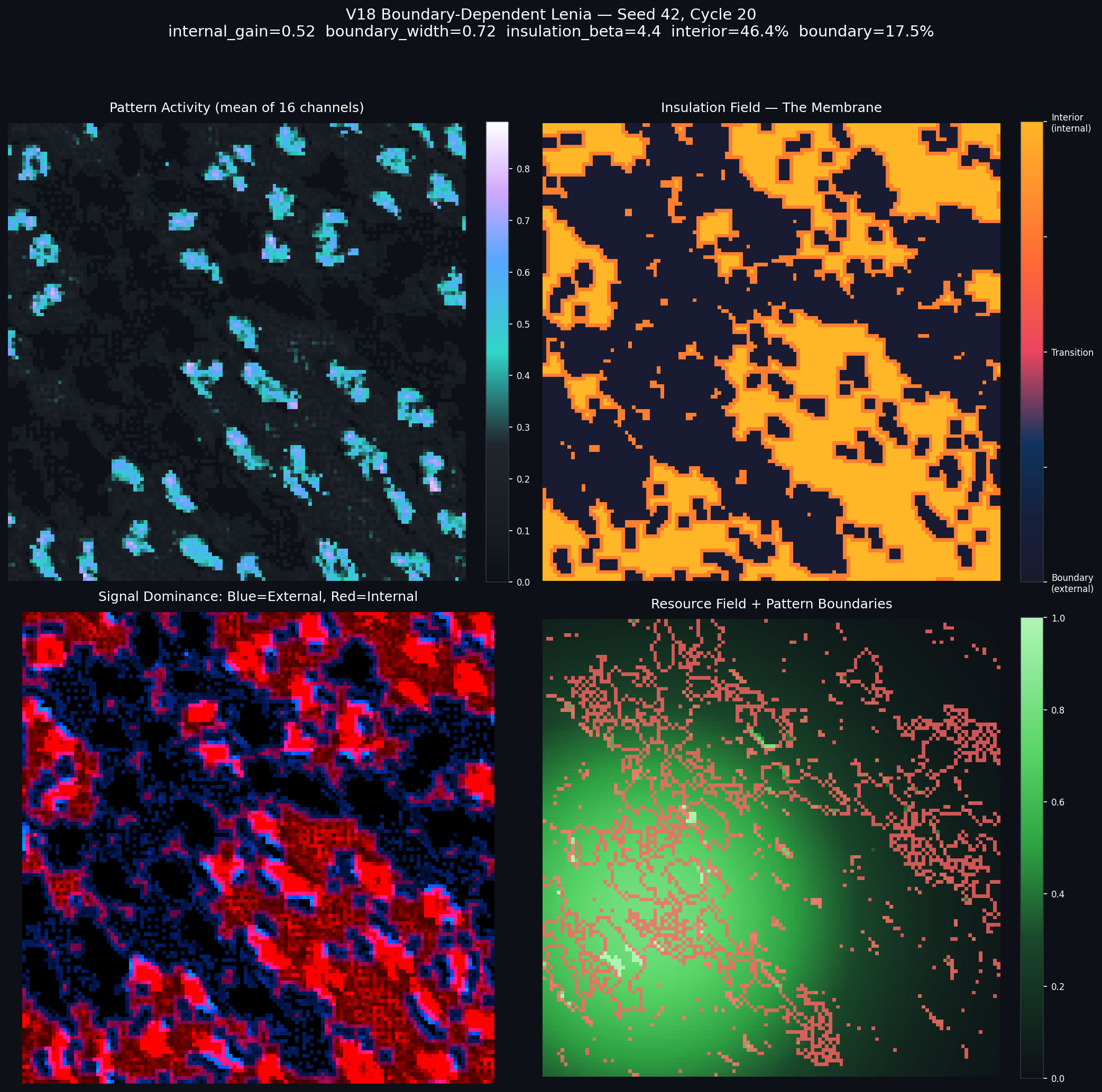
V18 parameter evolution. Left: internal gain evolves DOWN in all 3 seeds (starting ~1.0–2.5, converging below 1.0). Center: boundary width evolves UP (thicker membranes). Right: mean insulation field fluctuates. The convergent decrease in internal gain is the surprise — evolution consistently prefers permeable membranes over insulated cores. External sensing more valuable than internal rumination.Membrane evolution, seed 42. Top row: cycle 5 (early). Bottom row: cycle 20 (late). Left: pattern activity. Center: membrane field — at cycle 5 the membrane is tight (gain=1.09, bw=1.31); by cycle 20 it has loosened (gain=0.52, bw=0.12). Right: signal dominance — blue = external, red = internal. The shift toward red in specific regions shows that evolved patterns route information through the membrane rather than sealing it off.V18 snapshot (seed 42, cycle 20). Top-left: pattern activity across 16 channels. Top-right: insulation field — the evolved membrane with interior (orange, 46.4%) and boundary (pink, 17.5%) regions. Bottom-left: signal dominance showing where internal (red) vs external (blue) signals dominate processing. Bottom-right: resource field with pattern boundaries overlaid. The membrane creates genuine spatial compartmentalization without fully insulating the interior.